So how big of a battery should I buy?
This depends on the demand of your system. Assuming we are talking about a typical 24 volt firing system that will be used to shoot a show with anywhere from a couple hundred to a a couple thousand different shots, you want to go with something that will handle anything. So I would recommend at a minimum a 5A-h lead-acid (lead-acid = same type as your car battery but smaller) battery. Personally, I use a 7A-h, that way I can go a few shows in between charging them. Remember, you might be putting out a couple amps per shot, but your only producing that current in bursts for very short intervals. Your 7A-h batteries should last you a large number of shows before they would be considered dead. You could probably get away with shooting 15 or more shows on a single charge, but I wouldn't push your luck. I try to keep my batteries topped off for each show.
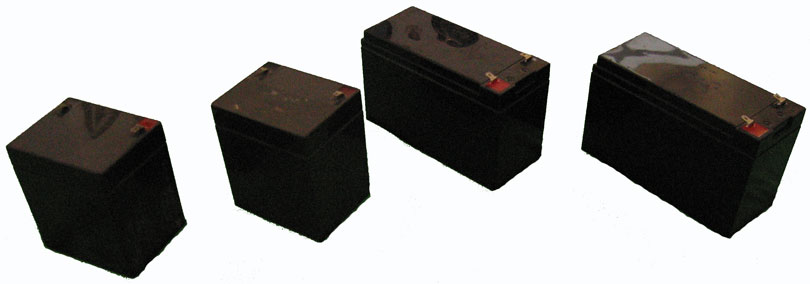
Lead-Acid Batteries Commonly Used for Firing Systems. Two on the left: 12V 5A-h, Two on the right: 12V 7A-h
What happens if I touch the black side of the battery to the red side of the battery?
You will probably have to change your underpants. This is know as "shorting" the battery. This is BAD!!! Don't do that. You are dealing with a large battery with a significant charge. If you were take a short piece of wire and touch the two sides of the battery together, you would get a blinding flash, a loud crack, and when the smoke clears, the end of your wire or the battery terminal itself would be melted. Yes I said the metal would be melted. This would happen almost instantaneously! Hopefully you can imagine the amount of energy that would take. You can read our electricity 101 tutorial for better understanding of why this happens. In the worst case scenario, the battery explodes, throwing acid all over the place including you. Needless to say, you could get hurt. Don't do it. Be careful when ever handling the batteries. Try to avoid having wires connected to the batteries just waving around unconnected. Your just asking for trouble. Because of this, it's a good general rule of thumb to first attach the battery cables to the firing board, then the batteries, so you avoid this possibility all together.
|
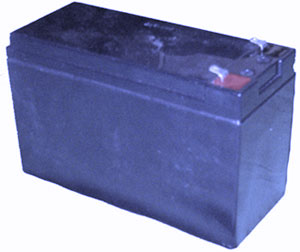 Firing Batteries