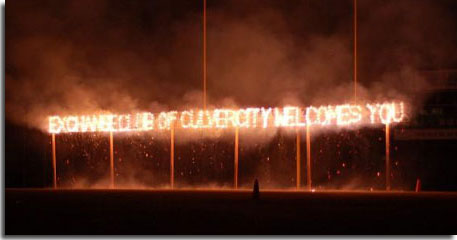
|
Step 1 - Arrange and secure different sections.
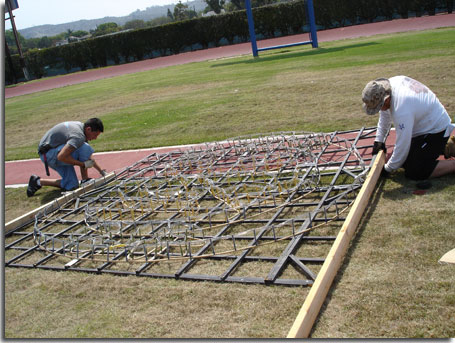
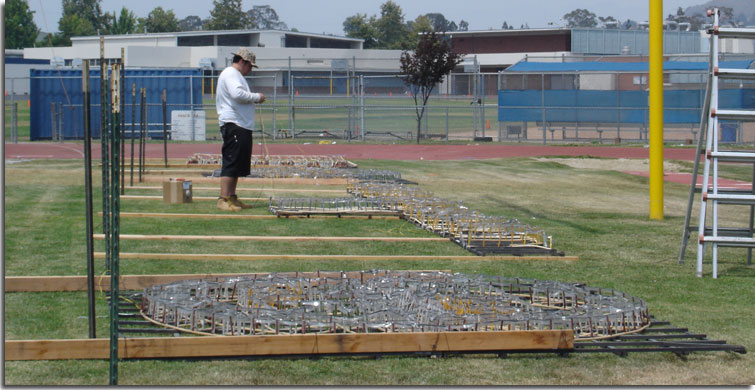
If you have a small, one section set piece, skip to step two. Some set pieces are large enough that they are fabricated and shipped in sections. If so, arrange the sections on a flat surface, and secure them together using bailing wire, as shown in the picture to the right.
Step 2 - Secure the uprights to the frame.
If your mounting your set piece to scaffolding or another pre-existing structure, then skip to step three. There is a hundred different ways in which a set piece could be mounted depending on the logistics of your location, which may or may not require uprights. 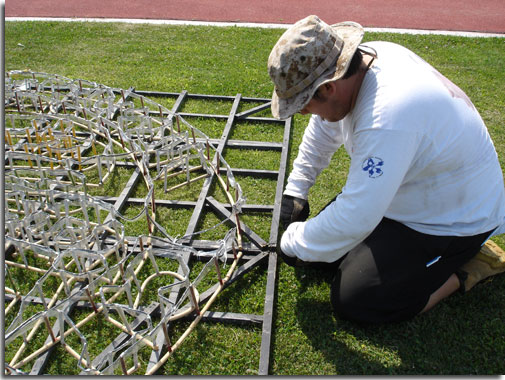 In this step, I will only cover the most commonly used method, where the uprights, which typically comprise of two by fours, are secured to the frame using bailing wire as shown in the picture. Ensure good friction contact between the frame and the uprights by twisting until the bailing wire begins to dig into the two by four during tightening. Depending on the size of your set piece, it may be appropriate to reinforce the structural frame with a two by four across the back side to prevent excessive amounts of torque from being applied to the frame once it is in the vertical position. In this step, I will only cover the most commonly used method, where the uprights, which typically comprise of two by fours, are secured to the frame using bailing wire as shown in the picture. Ensure good friction contact between the frame and the uprights by twisting until the bailing wire begins to dig into the two by four during tightening. Depending on the size of your set piece, it may be appropriate to reinforce the structural frame with a two by four across the back side to prevent excessive amounts of torque from being applied to the frame once it is in the vertical position.
Step 3 - Insert electric matches in each section.
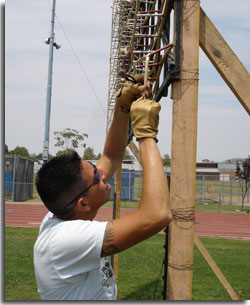
Insert an electric match in each section of the set piece as shown in the picture below. This will serve to have an ignition which occurs evenly over the length of the set piece, and provide redundancy.
Step 4 - Secure any loose match ends from different sections together.
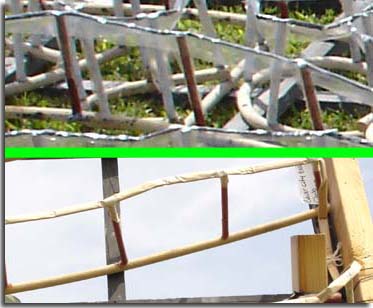
Particularly if the set piece comes shipped in sections, there will be loose match leads at the end of each section. These match leads need to be secured from section to section in as many places as possible, for the same reason mentioned in step three. There could be one of two different types of match used, either sticky match (top, above right picture) or quick match (bottom, above right picture).
Step 5 - Pound the highway stakes into the ground.
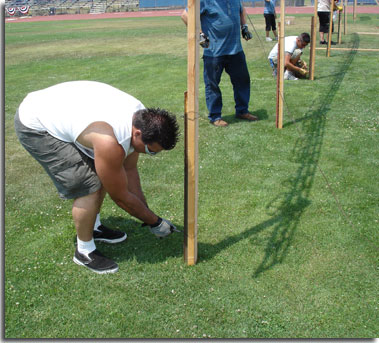
For this step, it is important to have brought a sledge hammer with you. First position the set piece in the spot you want it for show time. Then line up the highway stakes with the two by fours. Now your ready to pound the stakes into the ground as shown in the picture to the right. Note that steps three, four, and five are interchangeable, as it really doesn't matter which order you complete these in.
Step 6 - Secure the stakes to the two by fours.
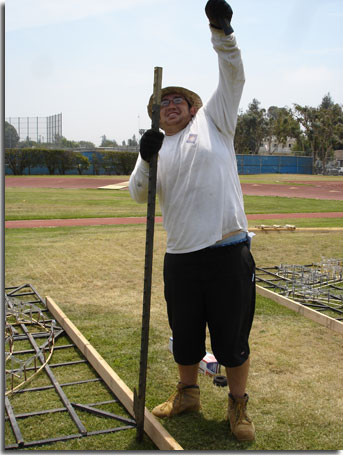
After all the stakes are in the ground (as shown in the picture above), you raise the set piece and apply a couple turns of bailing wire around the two by four and stakes. I typically use one piece towards the bottom of the stake and one towards the top as shown in the picture below.
Step 7 - Build the "A" Frame.
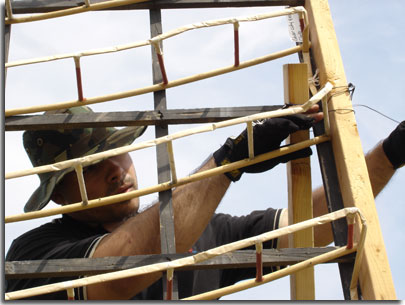
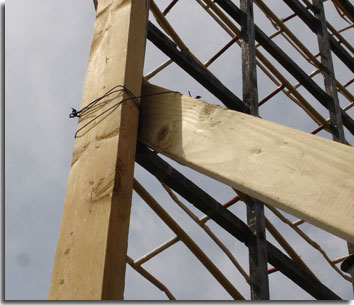
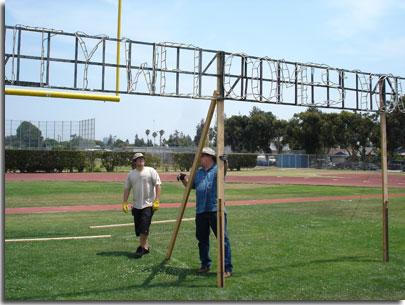
If you have a small set piece and don't need extra support, then skip to step eight. The "A-Frame" provides structural support when the set piece is large or there is an abundance of wind. The frame is built simply by attaching an angled two by four via bailing wire or screws to the existing two by fours as shown in the picture to the top right, top left, and bottom left.
Step 8 - Run zip wire from electric match.
All of your electric matches must now be wired into one circuit. I personally use a parallel scheme since the multiple matches in this case is for redundancy. Attach these wires to a piece of zip wire which will be run to your firing slave. At this point, you will also want to apply some type of simple strain relief to the e-match wires, such as wrapping them around a nail to avoid gravity from pulling them out of the set piece.
|