|
One thing you want to make sure you do is to be consistent with the angle between each rack. This is important so that you have an even spread of shells in the air. If you are limited to a really small area or you have one or two racks only (racks are generally fanned in groups of three to five), then another option available to you is to angle the guns within the racks. In other words, the rack is cleated strait up, and the guns are angled inside the racks themselves. This will provide a much smaller spread of the shells. A good point to remember when cleating the finale racks, is to make sure the base of the racks are all touching. This provides the most stability and the most spread for the given angle. The only two exceptions to the angled finale racks rule is if you have only bare minimum clearance to the audience, or you have multiple positions which are spread out from one another. The finale racks in a multiple aerial position shoot could have it's racks cleated strait up, since you will already have a spread due to the positions being distant from one another (although angling the guns still improves the look). Make sure you learn how to cleat fireworks finale racks.
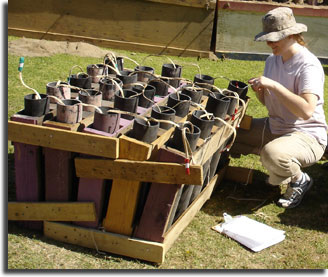 How do I load finale chains? How do I load finale chains?
A finale chain is defined as being a chain of shells (usually 5) which are quick matched together. These shells are made to function simultaneously during the finale via the quick match leads. These shells are loaded in the same manner as a single shot with a couple minor differences.
Make Sure Your Chains Are Loaded "Across" the Finale Racks - Across being defined as facing the audience with the racks in front of you, and stringing the chains from left to right. (See picture to the right) This way, the chains fire "across the sky" and you avoid the same effect as cleating your guns strait up. If you don't load your shells "across" you will see a ball of fire on the right, then a ball of fire next to it, so on and so forth, moving across the sky. Your sky will then never be "filled". You must think of everything from the perspective of the audience, i.e., "How will this look to the audience when fired in this manner?"
Keep Your Shells Untangled - Each shell will be branched off of the main quick match lead in a finale chain. Make sure you keep each shell in the order that it is attached to the chain. This will help prevent quick match blowouts during the show. When quick match fires, it's so violent that it pretty much explodes as it's "burning". If your quick match is tangled amongst itself, you have the increased risk of having it rip itself apart. You also chance having a piece of match belonging to a shell that has yet to get fired being blown apart from being tangled over another gun. It's best to avoid these situations and take the extra second to load the shells in order. Always redundantly match your finale!
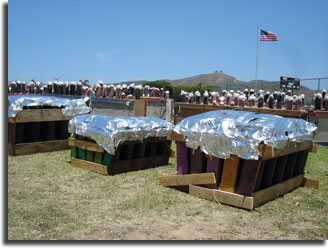
Why do we "foil" the finale racks?
We "foil" finale racks to keep our finale shells from igniting prematurely during the show. As you probably know, finale chains utilize quick match to transfer fire from one shells lift charge to the next in a very quick fashion. Since quickmatch is made of thin paper tubing and often has it's internal "black match" exposed at some points along the chain, this must be covered with a nonflammable material to prevent sparks coming from your show from pre-maturely igniting the finale. If you blow your finale first, your show will be very anti-climatic. If you haven't yet guessed, that's bad. Aluminum foil is the best material for the job since it has very good heat conduction, meaning it will disperse the heat from a spark on it very quickly, thus preventing the spark from burning through to reach your finale chains. The key to foiling your finale is to make sure all of the exposed quickmatch is covered. Make sure your finale is always upwind of your main show for the same purpose. If each of the chains in your finale rack is set off with a different cue, make sure you foil each chain individually.
Aside from the danger factor, keep in mind that most shells utilize cardboard for their casing. This cardboard must be able to hold up during the violent process of firing. This is most likely not the case if the shell has to really force it's way out of the mortar, especially if you have potentially damaged it by ramming it down there in the first place.
 What is the best way to connect all the chains in a multiple chain shot? What is the best way to connect all the chains in a multiple chain shot?
If you have, lets say, 5 chains (total of 25 shells) in one rack that you want to shoot with one cue, you have two main options for creating a reliable ignition. Keeping in mind that quickmatch is extremely violent with itself when it functions, you must count on it breaking somewhere along the chain while it's firing. You can:
Insert multiple electric matches at different places along the chains. - Assuming you have matched together every other end of each chain together forming a snake like pattern with your quickmatch, you would then insert an electric match at two opposite corners, and perhaps one right in the middle. This way you have multiple fire paths in case the quickmatch breaks somewhere along the line.
Match both ends of each chain to both ends of chains on either side of it. - In other words, if each chain of 5 shells is loaded across as discussed above, you would take the right side of the chain and match it to the right side of the chains directly in front and directly behind it. Then you do the same for the left side of each chain. This way you have many redundant fire paths.
Both of the above methods work very well, but keep in mind, the more redundant fire paths you have, the faster that entire rack will go up. With the second method mentioned above, you could expect the entire finale rack to go up in less than a second with proper matching. In other words, as reliability goes up, so does speed of your rack.
|
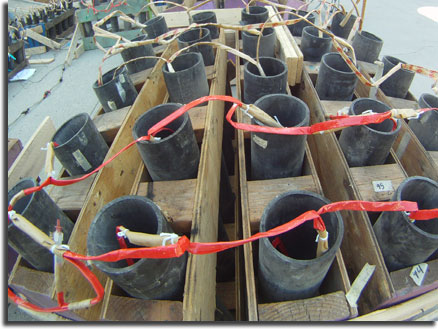 Finale Chains